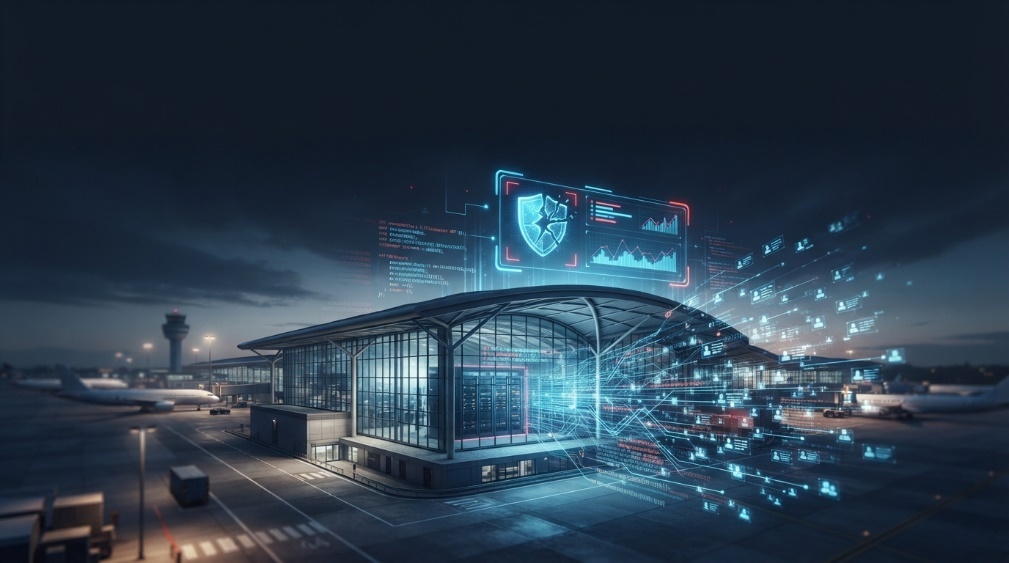
Three of the UK's busiest airports just learned that a single leaked API key can do more damage than any lock-picking hacker ever could. In late August 2026 at the Manchester Airports Group (MAG), the operator behind Manchester Airport, London Stansted, and East Midlands Airport confirmed a cybersecurity incident that exposed the personal data of roughly 8.7 million customers. Then, on September 2, the hackers behind the attack published the entire stolen dataset online after MAG refused to pay a ransom.
If you searched "UK airports hacked" hoping for a plain answer on what actually happened, you are in the right place. But there is a bigger story here for Canadian business owners, and it has very little to do with geography. The way this breach happened through an exposed credential instead of some dramatic system-wide takeover is the same weak point sitting inside thousands of Canadian company websites and marketing platforms right now.
Quick Facts About The MAG Airport Cyberattack
- Who: Manchester Airports Group (MAG), operator of Manchester, London Stansted, and East Midlands airports
- What: A cybersecurity incident in which an unauthorized third party accessed customer data
- When: Intrusion occurred over the weekend of August 22 to 23, 2026; discovered August 25; disclosed publicly August 27
- Records affected: Approximately 8.7 million (MAG has never confirmed a precise total)
- Data exposed: Email addresses, phone numbers, postal codes, vehicle registration numbers, Wi-Fi sign-up details, and booking records
- Data NOT exposed: Bank details, payment card numbers and account passwords
- Outcome: MAG refused a ransom demand; the extortion group FulcrumSec published the full dataset online on September 2, 2026
Breaching Three UK Airports: How the Weekend Intrusion Unfolded
The story of breaching three UK airports starts on a quiet weekend, not a dramatic one. Unauthorized access to MAG's systems is understood to have begun on August 22 or 23. Nobody at the company noticed until the following Tuesday, August 25, when MAG identified the intrusion and moved to shut it down.
Two days later, on Thursday, August 27, MAG went public. A company spokesperson described it plainly: "Manchester Airports Group has been subject to a cyber security incident by an unauthorised third party." That phrase, cyber security incident is doing a lot of quiet work. It's the term companies reach for when they want to describe unauthorised access without yet confirming whether ransomware, extortion, or straightforward data theft was involved.
MAG says it restricted access to the affected systems, brought in outside cybersecurity specialists, and notified the UK's National Cyber Security Centre and the Information Commissioner's Office. The ICO confirmed it had received a breach report and was assessing it, which is the standard first step for any incident touching UK residents' personal data.
To MAG's credit, the response looks disciplined on paper. As a precaution, the company temporarily suspended its online Manage My Booking service, but flights, security screening, and airport parking all continued to run normally throughout. MAG has maintained since day one that passenger safety and aviation security were never compromised at any point, a claim that has held up as the story developed over the following two weeks.
What Data Was Exposed, and What Wasn't
MAG has said the compromised information relates to four specific customer touchpoints: car park bookings, airport lounge access, Fast Track security bookings, and in-airport Wi-Fi sign-ups. According to reporting on the incident, the majority of the roughly 8.7 million affected records are simply email addresses collected when travelers connected to free terminal Wi-Fi, which typically asks for little more than a name and email to grant access.
A smaller subset of customers, those who paid for parking, a lounge, or Fast Track, had more exposed:
- Email addresses
- Phone numbers
- Postal codes
- Vehicle registration numbers
- Booking and travel-related details
What wasn't touched matters just as much. MAG has repeatedly stated that neither the company nor the affected system stores customers' bank details, payment card numbers, or account passwords. That's genuinely good news for anyone caught up in this, but it doesn't make the exposure harmless. Worth noting too: MAG's official statement never gave a precise headcount, describing only an unspecified amount of customer data. The 8.7 million figure comes from outlet reporting citing company sources, and it almost certainly counts records rather than unique people. Someone who parked at Stansted twice, signed up for airport Wi-Fi on three separate trips, and booked a Fast Track pass once could show up as five separate rows in that count.
How the Attackers Got In: A Supply Chain Story, not a Hollywood Hack
Here's the part that should genuinely worry Canadian businesses more than the headline number. According to reporting from BleepingComputer, the extortion group that later claimed the attack, known as FulcrumSec, said it didn't break through a firewall or exploit some obscure server vulnerability. It found an exposed Iterable API key sitting in MAG's client-side JavaScript, the code that runs directly in a visitor's browser and is technically visible to anyone who opens their browser's developer tools. Iterable is a third-party marketing automation platform, the kind of tool that powers email campaigns, booking confirmations, and customer communications for thousands of companies. MAG has not publicly confirmed this specific attack path, so treat it as the leading account rather than a settled fact, but it lines up with everything else known about how the breach unfolded.
If that's accurate, this wasn't a hack in the cinematic sense. It was a credential that should never have been visible, sitting in plain view, connected to a vendor system that held far more customer data than most people would guess a "marketing tool" ever touches. Security researchers have made a similar point about this incident more broadly: modern airports, like modern retailers, clinics, and professional service firms, sit inside a web of booking platforms, loyalty programs, payment processors, and marketing tools built and hosted by outside vendors. Every one of those connections is a potential doorway, and very few companies inventory them all.
This is precisely the gap that API security testing and secure application development practices are built to close. A basic code review or manual penetration test looking specifically for exposed credentials in client-side code would have caught this before an attacker did. It's not a glamorous fix. It's also one of the most common findings in real-world security assessments, which is exactly why it keeps showing up in breach reports.
The Ransom Refusal and the Data Dump
Around August 30, FulcrumSec publicly claimed responsibility, telling BleepingComputer it had taken roughly 86 gigabytes, close to half a terabyte of data from MAG's systems. This wasn't the group's first high-profile target. FulcrumSec emerged in 2025 and has previously claimed attacks on pharmaceutical giant Novo Nordisk, where it demanded 25 million dollars after allegedly stealing 1.3 terabytes of clinical trial data and internal AI models, and on data broker LexisNexis.
MAG confirmed to British media that hackers had demanded a ransom for the data and that the company refused to pay. The amount was never disclosed. That decision lines up with long-standing guidance from the UK's National Cyber Security Centre, which, like most Western cybersecurity agencies including Canada's own Canadian Centre for Cyber Security, advises against paying ransoms because it funds further crime and offers no real guarantee the data will be deleted rather than sold anyway.
The consequence played out exactly as security professionals warned it might. On September 2, the BBC reported that FulcrumSec had published the full dataset on the dark web, framing it as a mass release rather than a private sale, boasting in their post that the trove was "half a terabyte, and every byte of it is pure PII." The dataset was reportedly reviewed by breach-notification service HaveIBeenPwned and found to include browser and IP information, geolocation data, purchase histories, and vehicle registration plates alongside the previously disclosed contact details.
Once data like this is public rather than held privately by one criminal group, the risk shifts. It's no longer about one bad actor. It's about every scammer who can now build convincing, personalized phishing messages referencing a real booking, a real parking reservation, or a real Wi-Fi sign-up, at scale, with no technical skill required. Illumio's Raghu Nandakumara made a similar point when the breach first broke, warning that travel-related booking details make fraudulent messages far more convincing right before a peak travel period.
If your organization ever finds itself facing a similar decision under pressure, having an incident response plan and a forensics partner on call before an attack, not during one, is what separates a contained event from a slow-motion crisis.
Why This Isn't Just a UK Problem for Canadian Businesses
It's tempting to read this as a British story about a British airport operator. It isn't. Canadian aviation has already had its own version of this exact scenario.
In June 2025, WestJet confirmed that a criminal third party had gained unauthorized access to its systems. The airline later disclosed that the breach affected roughly 1.2 million passengers, exposing names, dates of birth, mailing addresses, passport numbers, and WestJet Rewards account details. Like MAG, WestJet said payment card numbers and passwords weren't compromised. Like MAG, the airline's flight operations continued without disruption. And like MAG, WestJet's breach triggered a formal investigation, this time by the Office of the Privacy Commissioner of Canada, announced in August 2025.
Canada's airports have felt a different flavour of this risk too. In October 2025, terminal flight information screens and public address systems at Kelowna International Airport and Victoria International Airport in British Columbia, along with Windsor International Airport in Ontario, were hijacked to broadcast pro-Hamas and anti-Trump messaging, delaying flights at Kelowna in the process. According to CityNews coverage of the incident, Kelowna Airport said the intrusion was traced to a cloud-based third-party software provider rather than the airport's own core systems, and staff removed the unauthorized messaging within minutes. Transport Canada confirmed it was working with federal security partners on the response. No personal customer data appears to have been involved, which makes it a different kind of incident than MAG's or WestJet's, but the entry point tells the same story once again: a vendor system, not the airport itself, was where the door was left open.
The parallels aren't a coincidence. Airlines and airports run on the same kind of sprawling, vendor-dependent technology stack everywhere in the world: booking engines, loyalty platforms, marketing tools, parking systems, public address and signage software, all stitched together and often managed by different third parties with varying security standards.
Two pieces of Canadian law make this especially relevant right now:
Bill C-8 and the Critical Cyber Systems Protection Act. Bill C-8 received Royal Assent on June 16, 2026, formally establishing the Critical Cyber Systems Protection Act (CCSPA). The CCSPA specifically covers federally regulated organizations in the finance, telecommunications, energy, and transportation sectors, which includes federally regulated airlines and airport operators. Designated operators in these sectors are now legally required to build and maintain a documented cybersecurity program, actively manage supply chain and third-party vendor risk, and report significant cyber incidents to their sector regulator. Corporate penalties for non-compliance run up to 10 million dollars, rising to 15 million for repeat violations. If we've helped you navigate what this means for your business before, you can catch up on it in our breakdown of [Bill C-8 and what it means for Canadian companies]
PIPEDA's mandatory breach notification rules. Even outside the federally regulated sectors CCSPA targets, any organization subject to PIPEDA must report a breach to the Office of the Privacy Commissioner of Canada, and notify every affected individual, whenever the breach creates a "real risk of significant harm." That threshold is assessed by weighing how sensitive the exposed information is against how likely it is to be misused, and Canadian courts and regulators have interpreted it broadly. Organizations must also keep a record of every breach, regardless of severity, for two years. Notification has to happen "as soon as feasible," not on a leisurely timeline.
Put simply: if a Canadian airline, retailer, or service business experienced what MAG just went through, silence would not be a legal option.
What Canadian Businesses Should Take from This Breach
You don't need to run an airport for this to apply to you. Any business with a customer-facing website, a booking system, a loyalty program, or a third-party marketing platform is running the same category of risk MAG just discovered the hard way. A few practical takeaways worth acting on:
- Audit every third-party integration touching customer data. Marketing platforms, booking widgets, chat tools, and loyalty systems often hold more personal information than the teams managing them realize. Know what's connected, and know what each vendor can actually access.
- Get client-side code checked for exposed credentials. API keys, tokens, and secrets embedded in JavaScript that runs in a browser are effectively public. A manual penetration test looks for exactly this kind of exposure, not just the automated-scanner findings a bot would catch.
- Review cloud and vendor access controls regularly, not just at setup. Permissions drift over time as staff change, and integrations get added. Our cloud and infrastructure security reviews are built around finding exactly these kinds of gaps before an attacker does.
- Put continuous monitoring in place. MAG caught this within days, not months, which limited the damage considerably compared to breaches that go undetected for half a year or more. 24/7 SOC monitoring is what makes that kind of fast detection possible for businesses without an in-house security team.
- Know your compliance obligations before an incident happens, not during one. If PIPEDA or Bill C-8 applies to your organization, your breach response clock starts the moment you discover a problem, not once you've figured out what to say about it. Our compliance and risk management team can walk you through exactly where your business stands.
We wrote about a similarly large-scale breach earlier this year in our piece on the OnlyFans data leak, and the pattern is becoming familiar: it's rarely the core system that gets breached first. It's the peripheral, customer-facing tool nobody thought to lock down.
-
If You Think Your Data Was Exposed
If you've booked airport parking, a lounge, or Fast Track security, or connected to free Wi-Fi at Manchester, Stansted, or East Midlands airport in recent years, here's what's worth doing regardless of whether you received a notification email from MAG:
- Be wary of unexpected emails, calls, or texts referencing a car park booking, lounge reservation, Fast Track pass, or airport Wi-Fi sign-up. Verify anything through the airport's official channels directly, never through a link in the message itself.
- Turn on multi-factor authentication for any account tied to the email address you used at these airports.
- Use a unique password for that account if you haven't already, especially if you've reused it elsewhere.
- Keep an eye on your inbox for messages that look like they're from MAG, Manchester Airport, Stansted, or East Midlands but ask you to "confirm" payment or banking details. MAG has said it will never contact customers unexpectedly to request this information.
Frequently Asked Questions
Was I affected by the Manchester Airports Group breach? If you booked parking, a lounge, or Fast Track security, or signed up for free Wi-Fi at Manchester, Stansted, or East Midlands airport, your email address and possibly your phone number, postal code, or vehicle registration may have been in the exposed data. MAG says it contacted affected customers directly by email.
Did the hackers get bank or credit card details? No. MAG has stated consistently, from its first disclosure through to the data publication, that the affected systems never stored payment card or banking information.
Is this connected to any Canadian airline or airport? Not directly. This breach affected UK-based Manchester Airports Group only. It does, however, echo two recent Canadian incidents: the 2025 WestJet breach, where a criminal third party accessed passenger data and prompted a formal investigation by the Office of the Privacy Commissioner of Canada, and the October 2025 hack of terminal screens at Kelowna, Victoria, and Windsor airports, which was traced to a third-party software provider. Different attacks, same underlying lesson about vendor risk.
Would a breach like this trigger reporting requirements in Canada? In most cases, yes. Under PIPEDA, any organization experiencing a breach that creates a real risk of significant harm must report it to the Office of the Privacy Commissioner of Canada, notify affected individuals, and keep records for two years. If the organization falls under a federally regulated sector such as transportation, energy, telecommunications, or finance, Bill C-8's Critical Cyber Systems Protection Act adds further mandatory reporting duties on top of that.
What's the single biggest lesson from this breach? It didn't come from a sophisticated zero-day exploit. It came from a credential sitting in plain sight in client-side code, tied to a third-party marketing platform. That's a solvable, findable problem, and it's exactly the kind of gap a proper security assessment is designed to catch before an attacker does.
The Takeaway
The MAG breach is a reminder that the biggest risk to a modern business often isn't the system you're watching closely. It's the vendor integration, the marketing tool, or the booking widget nobody's looked at since it was set up. Eight and a half million exposed records started with one key that shouldn't have been visible.
If you're not entirely sure what's connected to your own customer data right now, that's worth finding out before someone else does. PlutoSec's certified engineers run manual-first penetration tests, API security assessments, and compliance reviews built around exactly this kind of real-world risk, backed by CREST accreditation and a proven track record across Canadian industries. Book a free consultation and get a clear picture of where your business actually stands.

Written by
Jonathan Zachary